

 TecnoSpeed's PlugDFe Electronic tax documentsPlugDFe Suite Tax components
 PlugNotas Invoice issuance API
 PlugStorage Fiscal Document ManagerSPED XML Automate your SPED Fiscal
 DecisionIT Efficiency and safety during tax reform
 PlugBank Financial Solutions HubPayment Slip API Issuance, registration, and reconciliation of payment slipsOpen Finance Statement Integration of bank statements and card invoicesAPI Pix Pix payment integrationAccounts payable Automation of the entire financial routine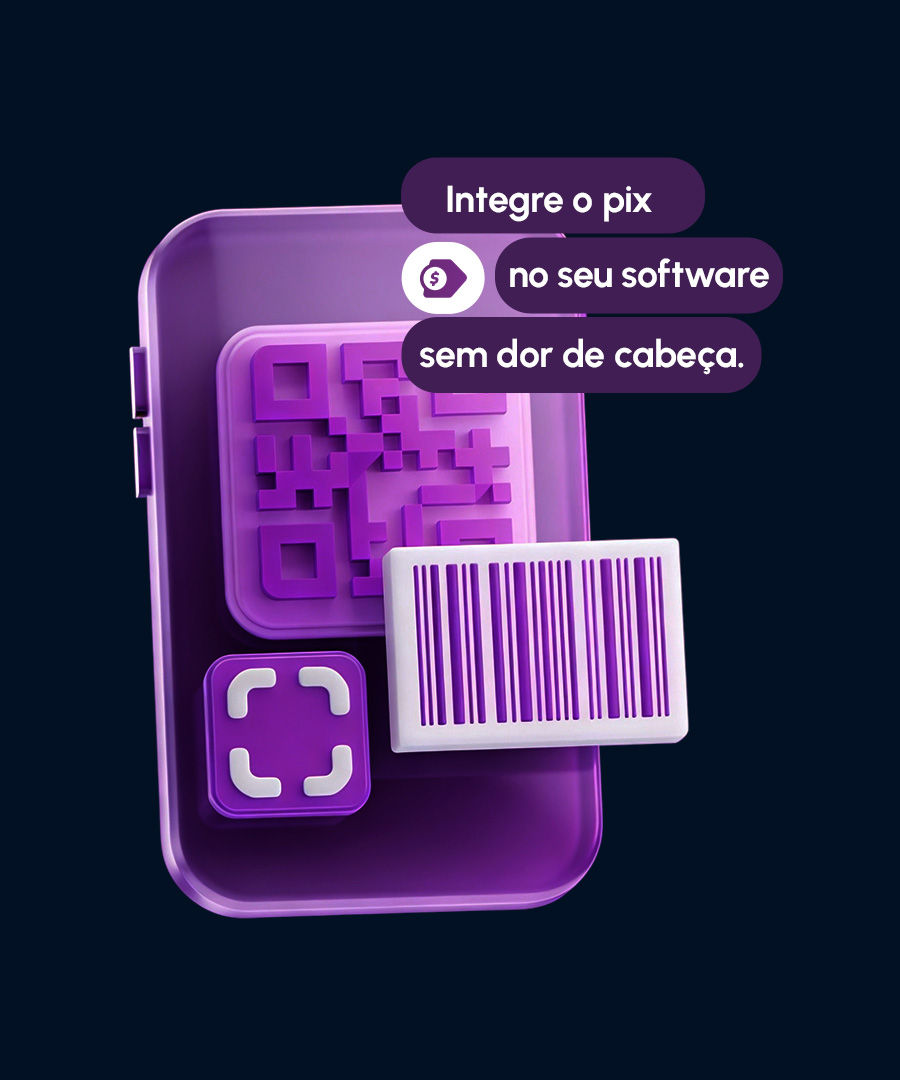
Each bank has its own accreditation, certification, and testing process. Each approval can take months and requires ongoing maintenance.
Itaú, Bradesco, BB, each has distinct endpoints, formats, and rules. Your team needs to learn and maintain each one separately.
A bank update could break the integration overnight. Your roadmap entails chasing a bank change.
If the customer doesn't have an account at one of the approved banks, they can't use Pix. The solution doesn't scale to the entire portfolio.
Using a static key for charges is insecure and not scalable. Without a txid, there's no automatic reconciliation, no identifying who paid for what.
ERP makes a JSON request to the PlugPix API with payer data, amount, and charge type.
The payer scans the QR code in the bank app and authorizes the payment instantly.
The API receives confirmation from the bank and triggers the Webhook to the ERP in real-time.
ERP records receipt, updates e-invoice, and closes reconciliation, without manual action.
All orchestrated by the API. Your team writes a single integration; homologation, maintenance, and regulatory updates are on us.
POST /v1/cob
{
  "account ID": "customer-account-123",
  "description": "March 2026 Tuition",
  "calendar": {
    "dueDate": "2026-03-31",
    "daysAfterDueDate": 5
  },
  "payer": {
    "CPF/CNPJ": "12.345.678/0001-90",
    "name": "ABC Company"
  },
  "value": {
    "original": 1500.00,
    "fine": {},
    "interest": {},
    "discount": {}
  }
}
Dynamic QR Code + Copy and Paste Code ready to present to the payer. Webhook confirming receipt once payment is processed.
For unmaturing charges, POS, standalone sales, and one-time charges. Each transaction generates a unique and trackable QR Code with txid.
For monthly fees, invoices, and accounts receivable with due dates. Supports fines, interest, and discounts, all in JSON.
Itaú, Bradesco, Banco do Brasil, Santander, Sicredi, Sicoob, and GerenciaNet, without bank-by-bank approval. Single layout, no institution-specific rules.
Each charge is tracked by a unique txid. Dynamic QR Code ensures that each transaction is identified, with no code reuse, no duplicate payments, and no key change fraud.
As soon as payment is confirmed, the ERP receives the notification automatically, without polling or user intervention to check the bank. Payment status is always updated.
Every time a bank updates its Pix API, TecnoSpeed absorbs the change. Your development team doesn't stop the roadmap to resolve a bank issue.
Same request pattern for all modalities and all banks. Sandbox available for testing. docs.pix.tecnospeed.com.br with complete code examples.










Integrate Pix the old way: each bank, each API, each homologation done manually and maintained forever.
A single architecture connects the ERP to banks, with real-time Webhooks, unified JSON, and maintenance/approval handled by TecnoSpeed.
Everything to run your first Pix charge: registration, credentials, bank account setup, and the initial payment call.
See first stepsRequest JSON, response, and code examples. Status and charge listing with filters.
View QR Code documentationGeneration of charges with due date, fines, interest, and discounts. Pagination and filters by status, tax ID, and dates.
View Cobv documentationServer setup, PAYMENT_CONFIRMED, PROCESSING, and FAILED events, payload examples.
View Webhooks documentationIssuance of hybrid bank slip with integrated Pix QR Code. Step-by-step setup, printing, and queries.
View Bank Slip documentation
“An ERP integrated with a Pix API enables fully connected financial and fiscal management, making all the difference in positioning your Software House more competitively.”
TECNOSPEED BLOG · PIX API FOR COMPANIES
PlugPix API is a solution built for Software Houses and IT teams that need to integrate Pix billing into ERPs and management systems. With a single integration and a standardized JSON layout, your ERP can issue Dynamic QR Codes, Pix Billing with due dates (interest, fines, and discounts), Hybrid Bank Slips, and Pix, without individual bank approvals or managing separate integrations.
Currently, PlugPix API is integrated and approved for Itaú, Bradesco, Banco do Brasil, Santander, Sicredi, Sicoob, and GerenciaNet (Efí).
No. That is the main advantage of PlugPix API: your Software House integrates once and gains access to all supported banks. TecnoSpeed handles and maintains all bank approval processes and standardized Pix generation. When a bank updates its implementation, TecnoSpeed absorbs the change with zero impact on your ERP code. sem impacto no código do seu ERP.
A Dynamic QR Code is generated for each transaction, contains full billing details (amount, payer, txid), and allows automated reconciliation in the ERP. Static Pix keys were designed for personal transfers—they don't identify the payer, lack transaction tracking, and don't allow automated reconciliation. For business billing, Dynamic QR Code is the correct standard recommended by the Central Bank.
A Hybrid Payment Slip combines a traditional barcode with a Dynamic Pix QR Code on a single document. Payers choose how to pay. If they choose Pix, settlement is instant and the slip is automatically cancelled/cleared at the bank with no D+1 clearing wait. The API generates the Hybrid Slip in a single request. Regulated by the Central Bank, it is currently available for Banco do Brasil via PlugPix.
Once you set up a Webhook receiver server, the PlugPix API notifies your ERP instantly whenever there is a status update (PAYMENT_CONFIRMED, PAYMENT_PROCESSING, PAYMENT_FAILED). This eliminates periodic polling and ensures the ERP reflects real-time payment status without users checking bank apps.
Yes. One feature of the PlugPix API is automatically logging Pix receipts into fiscal documents/e-invoices as required by current regulation. This eliminates manual entries and keeps your ERP compliant effortlessly.
Yes. All payments processed by the Payments API undergo real-time security validation (assignor data verified, barcodes validated, limits checked). PlugBank operates with SSL, PCI DSS, LGPD compliance, and Brazilian banking regulations. Open Finance APIs use OAuth 2.0, FAPI, and mTLS—the strictest financial security standards regulated by the Central Bank.